SpinDog Verification and KYC: Documents, Payout Checks and Privacy
 Available in GB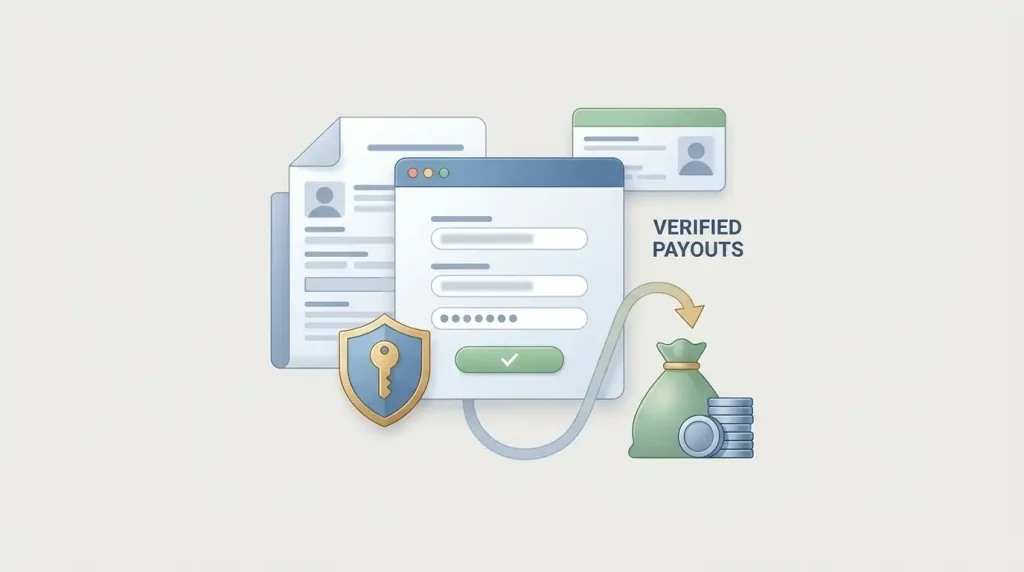
Identity and payout checks
SpinDog can require identity verification before processing a payout. Its current Terms give examples of documents that may be requested, including ID, payment-system details and utility bills, while the Privacy Policy also refers to proofs such as passport scans, payment slips and bank statements. These are examples, not a guaranteed or exhaustive checklist for every account. The practical point for a UK player is that accurate account data and readable evidence can become important before cash-out, while SpinDog does not state a fixed KYC processing time in the terms cited on this page.
Verification snapshot
Table of Contents
- What SpinDog's own policies say about KYC
- SpinDog describes several types of proof rather than one universal document pack
- Why KYC can become visible at the cash-out stage
- False or inconsistent personal data can affect both the withdrawal and the account
- What SpinDog says it uses verification data for
- 2FA protects account access but should not be confused with KYC
- Where verification fits into the wider SpinDog account journey
- Think in categories of proof rather than assuming one fixed KYC checklist
- A KYC review and a payment-method timetable are separate stages
- Verification data should be treated as sensitive account material
- How SpinDog verification can affect a UK player's cash-out
What SpinDog’s own policies say about KYC
| When verification can matter | Before a payout is processed |
|---|---|
| Terms examples | ID, payment-system details and utility bills |
| Privacy-policy examples | Passport scans, payment slips and bank statements |
| False personal data | Can lead to refusal of a withdrawal and account termination under the Terms |
| Extra account security | Two-factor authentication can be enabled |
| Published KYC processing time | No fixed time stated |
The document examples above are drawn from SpinDog’s current Terms and Privacy Policy. They should not be treated as a promise that every player will be asked for exactly the same set.
Examples, not a rigid checklist
SpinDog describes several types of proof rather than one universal document pack
Identity and address evidence
The Terms say account verification may involve ID and utility bills. The Privacy Policy separately gives passport scans as an example of documents that can be requested for verification, deposits, withdrawals or anti-fraud checks.
That wording matters because it describes categories and examples. It does not establish that a passport plus a utility bill is mandatory for every withdrawal, nor does it establish a fixed number of documents.
Payment-related evidence
The Terms also mention payment-system details. The Privacy Policy gives examples such as payment slips and bank statements. These types of evidence can connect the account holder to the payment route used to fund or withdraw from the account.
A useful preparation step is therefore to keep the payment method in the same name as the casino account and retain ordinary transaction records. SpinDog’s Terms separately prohibit third-party deposits, so payment ownership and identity checks can overlap in practice.
Before a withdrawal
Why KYC can become visible at the cash-out stage
SpinDog’s withdrawal policy expressly reserves the right to check identity before processing payouts. It also says the operator may hold a refund or withdrawal for the time needed to perform that check. SpinDog does not state a fixed number of hours or days for ordinary KYC review in the cited terms, so no fixed completion time is presented here.
This is different from saying that every withdrawal is automatically delayed for verification. The Terms establish a right to carry out the check, not a guarantee that every player will pass through the same workflow at the same point.
For someone preparing a first cash-out, the useful sequence is to make sure the account profile matches the identity documents, make sure the payment route belongs to the account holder and respond to any evidence request with clear, current material.
Data consistency
False or inconsistent personal data can affect both the withdrawal and the account
The current Terms state that if false personal data is provided, a withdrawal can be refused and the player account can be terminated. They also identify false registration information and forged documents as conduct that can trigger anti-fraud action. That makes accuracy more than a formality: details entered when opening the account can later be compared with evidence supplied during verification.
For a UK player, common-sense preparation is simple. Use your real legal identity, keep the same spelling across the casino account and supporting documents, avoid third-party payment methods and correct genuine profile errors through support rather than trying to work around them. The site does not publish enough detail to promise how every correction request will be handled, so that should be resolved directly in the account or through support if needed.
Privacy context
What SpinDog says it uses verification data for
Account verification
The Privacy Policy says personal data can be used to verify identity and carry out required checks. It also says documents may be requested to verify the account.
Payments and anti-fraud
The policy connects requested proofs with deposit and withdrawal processing and anti-fraud checks. It also describes transaction monitoring for fraud, abuse and money-laundering controls.
Retention and access
The Privacy Policy says selected staff roles involved in payments, anti-fraud, support and account management may access personal data where needed for their duties.
Account security
2FA protects account access but should not be confused with KYC
SpinDog’s Privacy Policy says players can enable two-factor authentication as additional protection against unauthorised account use. That is a useful security control because a password alone can be compromised or reused elsewhere.
2FA and identity verification solve different problems. Two-factor authentication helps protect access to the account. KYC is used to establish or confirm identity and can be connected to payment and withdrawal checks. Enabling 2FA does not remove the possibility of a later verification request.
Connected account checks
Where verification fits into the wider SpinDog account journey
The registration guide covers the checks worth making before the first deposit, while this page concentrates on identity and evidence. For a payout, the separate withdrawal guide explains the published minimums and cash-out mechanics without duplicating the KYC detail here.
The site’s licence check is also deliberately separate. Identity checks, privacy controls and 2FA can all exist regardless of whether a specific local licence claim has been verified. Keeping those questions separate avoids using one kind of evidence to imply another.
Evidence preparation
Think in categories of proof rather than assuming one fixed KYC checklist
SpinDog’s policies give examples of evidence that can be requested, but they do not establish one universal pack that every player must submit. The useful way to prepare is by category: evidence that supports identity, evidence that supports address information and evidence connected to the payment method. That keeps the examples in the terms useful without turning them into a guaranteed list.
This distinction matters because a verification request is tied to what the operator needs to confirm in a particular account. An identity document and a utility bill can support different facts, while payment-system details relate to the funding or payout route. The presence of an example in the terms does not mean every account will be asked for every example.
Accuracy is therefore more important than trying to predict the exact document set in advance. Keep account details consistent with legitimate records and be ready to provide evidence only through the operator’s current secure process if requested.
Payout timing
A KYC review and a payment-method timetable are separate stages
When verification is requested before payout, the review can affect when the withdrawal proceeds. That does not make the bank-transfer processing statement a KYC deadline. The withdrawal guide treats bank-transfer timing as a payment-route fact, while verification is an account-review step for which no single fixed completion time is published in the cited terms.
Keeping those stages separate avoids false precision. If a payout is waiting on documents, the useful question is whether the requested evidence has been supplied accurately. Once the account check is complete, the chosen payment route has its own processing mechanics. Combining the two into one promised number would overstate what the official material supports.
Privacy in practice
Verification data should be treated as sensitive account material
The documents used for identity, address or payment checks can contain more sensitive information than ordinary profile data. SpinDog’s Privacy Policy links this information to identity verification, payments and anti-fraud work, so a sensible account routine is to submit requested material only through the operator’s current account or support process and to keep login access protected.
Two-factor authentication supports that routine by adding an account-access control, but it does not verify identity and it does not replace requested evidence. The two controls complement each other: one helps protect access to the account, while the other supports checks about who owns or is using it.
UK cash-out preparation
How SpinDog verification can affect a UK player’s cash-out
The clearest point in SpinDog’s policies is that identity may be checked before a payout is processed, with examples spanning identity, address and payment evidence. The Terms also make accurate personal data important because false details can lead to a refused withdrawal and account closure. No fixed KYC processing time is published in the cited terms, so the sensible approach is to prepare accurate records rather than plan around an assumed deadline. Enabling 2FA adds account security, but it does not replace identity verification when SpinDog requests it.
SpinDog Games UK: Slots, Table Games and Providers
SpinDog Licence UK: UKGC Status, Trust Signals and What Is Verified
SpinDog UK Guide UK licence checkNo UK Gambling Commission licence was verified for SpinDog in...

SpinDog Bonus UK: Welcome Offer, Free Spins and Key Terms
SpinDog UK Guide Current GBP welcome offer SpinDog's current GBP-facing welcome package is 150% up...

SpinDog Registration UK: Account Setup, Currency and First Deposit
SpinDog UK Guide Before you register Before creating a SpinDog account from the UK, the...

SpinDog Games UK: Slots, Table Games and Providers
SpinDog UK Guide Current catalogue view SpinDog's current catalogue includes slots, jackpot titles, table games...
SpinDog Payment Methods UK: GBP Deposits, Withdrawals and Crypto
SpinDog UK Guide GBP payment mechanics SpinDog's current terms support GBP for both deposits and...

SpinDog Mobile UK: Browser Play, iPhone and Android Checks
SpinDog UK Guide Browser-first mobile accessSpinDog's confirmed mobile route is browser play: its official FAQ...