SpinDog UK Player Rules: Cards, Slot Limits, Deposit Limits and Tax
 Available in GB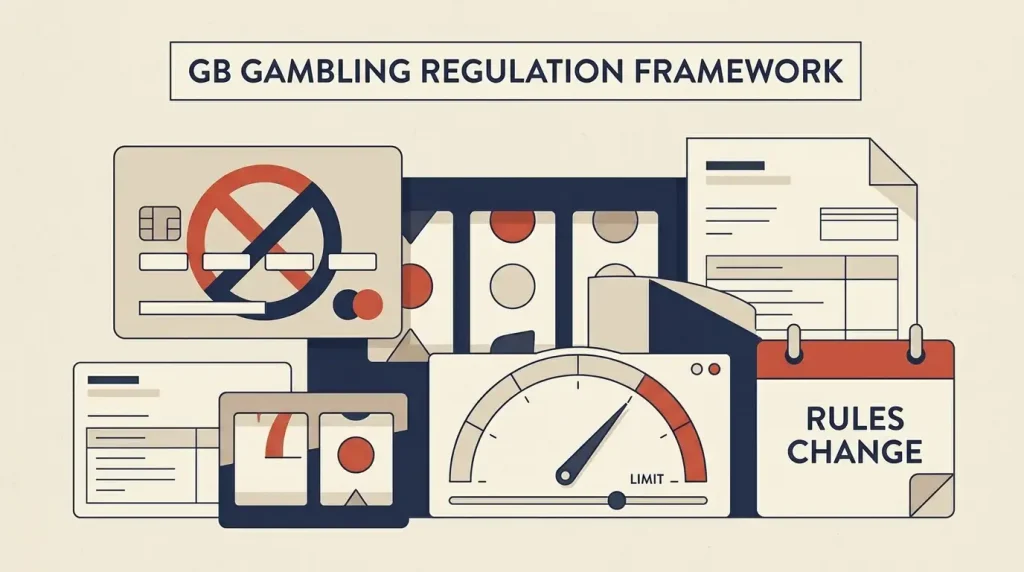
Great Britain rules
UK Gambling Commission rules set important standards for licensed Great Britain operators, but those standards should not automatically be described as SpinDog account controls. The key UK rules include a credit-card gambling ban, online slot stake caps of £5 for customers aged 25 and over and £2 for ages 18 to 24, light-touch financial vulnerability checks in the remote sector, and new gross deposit-limit requirements taking effect on 30 September 2026. HMRC also states that ordinary gambling winnings from wagers and bets are generally not taxed as income for ordinary punters.
Scope first
Table of Contents
- UK market rules and SpinDog-specific evidence are different layers
- Great Britain licensed operators cannot accept credit cards for online casino gambling
- The current UKGC caps are £5 for age 25+ and £2 for ages 18 to 24
- Light-touch financial vulnerability checks are part of the UK remote framework
- The new gross deposit-limit rules start on 30 September 2026
- A gross deposit limit measures money paid in before subtracting withdrawals
- HMRC generally does not tax ordinary gambling winnings from wagers and bets as income
- UK rules do not become verified SpinDog protections just because they are familiar to UK players
- Use the UK framework as a checklist of questions, not as an assumption
- Which UK protections can – and cannot – be assumed at SpinDog
UK market rules and SpinDog-specific evidence are different layers
| Rule or context | Great Britain position | SpinDog implication |
|---|---|---|
| Credit cards | UKGC-licensed operators must not accept them for online casino gambling | Do not treat this as a verified SpinDog cashier control without UKGC status |
| Online slots | £5 maximum stake per game cycle for age 25+, £2 for age 18-24 | These caps attach to remote casino licences in Great Britain |
| Financial vulnerability checks | Light-touch checks are required in the remote regulated sector | Do not imply a specific SpinDog check flow |
| Gross deposit limits | New RTS requirements take effect 30 September 2026 | They are a UKGC operator requirement, not independently verified SpinDog functionality |
| Ordinary winnings tax | HMRC does not generally tax gambling winnings from wagers and bets as income for ordinary punters | General tax context only, not personalised advice |
Credit cards
Great Britain licensed operators cannot accept credit cards for online casino gambling
The UK Gambling Commission’s credit-card rule has applied since 14 April 2020. Its guidance says operators in online betting, casino and bingo must not accept credit-card payments for gambling. Operators accepting e-wallet payments must also take steps so that gambling deposits are not funded by a credit card through the wallet.
The rule is useful context when looking at any UK-facing casino cashier, including the payment options discussed in the SpinDog payments guide. The important scope point is that this is a UKGC requirement for the regulated Great Britain market. Because this guide does not verify a UKGC licence for SpinDog, it does not convert the rule into a claim that SpinDog’s cashier necessarily enforces the same control.
For a reader, that means two checks are needed: understand what UKGC-licensed operators are required to do, and separately verify which methods SpinDog actually presents and accepts under its own current terms.
Online slot stakes
The current UKGC caps are £5 for age 25+ and £2 for ages 18 to 24
The maximum stake rule applies to online slots offered under remote casino operating licences. The £5 limit for adults aged 25 and over went live on 9 April 2025. The £2 limit for customers aged 18 to 24 went live on 21 May 2025.
The Commission describes the cap per game cycle. It also makes clear that the rule is for online slots rather than every casino product. Games such as roulette and blackjack are outside this particular online-slot stake-limit condition.
When reviewing the SpinDog games catalogue, the useful comparison is therefore not “all casino games must have a £5 cap”. The accurate benchmark is narrower: UKGC-licensed online slots must observe the age-based per-cycle maximums.
Financial vulnerability
Light-touch financial vulnerability checks are part of the UK remote framework
The Gambling Commission says light-touch financial vulnerability checks became a requirement on remote gambling businesses from August 2024. The checks use publicly available information to identify customers who may be particularly financially vulnerable, with the Commission citing examples such as bankruptcy information.
This is a regulatory framework point, not a description of a specific SpinDog screen or account event. Without verified UKGC status, this guide does not say that SpinDog performs the Commission’s vulnerability-check process, uses the same triggers or gives customers the same regulated safeguards.
The distinction matters because the phrase “financial check” can cover very different things. Identity verification, payment-source reviews, affordability processes and the Commission’s light-touch vulnerability checks should not be merged into one generic KYC claim. For SpinDog-specific identity checks, use the separate account verification material rather than treating UK policy as evidence of brand behaviour.
Deposit limits
The new gross deposit-limit rules start on 30 September 2026
As of 28 September 2026, the second phase of the Commission’s updated financial-limit rules is still upcoming. The implementation date is 30 September 2026. From that date, UKGC-licensed operators must offer gross deposit limits and only limits meeting the gross-deposit definition can be called a “deposit limit” under the updated standard.
The Commission’s published wording says gross deposit limits must be offered at least as prominently as other financial limit types. The available periods must include 24 hours, seven days and one month. If a customer sets overlapping time frames, the most restrictive applicable limit must operate.
This date detail matters because a review written just before implementation can easily present a future requirement as if it were already in force. For SpinDog specifically, the rule remains market context. It should not be used to claim that a SpinDog account currently offers the UKGC-defined gross deposit-limit control.
What gross means
A gross deposit limit measures money paid in before subtracting withdrawals
The updated UKGC wording defines a gross deposit limit around the amount a customer deposits into the account over a chosen duration. That differs from a net deposit concept, where withdrawals are subtracted from deposits.
The Commission decided that gross deposit limits must be offered as a minimum, while operators can also offer other types of financial limits. This creates a more consistent baseline for consumers comparing regulated accounts, because the term “deposit limit” will have a defined meaning in the UKGC technical standards from 30 September 2026.
For readers comparing payment controls, this is more useful than simply asking whether a site has “limits”. The type of limit, the time period and the treatment of withdrawals all change what the number actually constrains.
Tax context
HMRC generally does not tax ordinary gambling winnings from wagers and bets as income
HMRC’s Business Income Manual states that miscellaneous-income provisions do not tax gambling winnings from wagers and bets. Its wider gambling guidance also explains that betting and gambling, as such, do not normally amount to a trade simply because a person gambles frequently or systematically.
For an ordinary UK player, the practical headline is that casino winnings are generally not treated as taxable income merely because they came from a wager or bet. That is a general tax position, not personalised tax advice. Different facts can matter where gambling is connected with a separate business, service arrangement or other taxable activity.
This tax point is also independent of SpinDog’s licence position. It describes HMRC’s treatment of ordinary gambling winnings, not an endorsement of a particular operator or a statement about where a person should gamble.
What not to infer
UK rules do not become verified SpinDog protections just because they are familiar to UK players
A UK player may reasonably expect licensed Great Britain operators to follow the Commission’s rules on cards, online-slot stakes, financial checks and technical standards. The problem is assuming that familiarity proves the same controls exist on every casino website that accepts GBP or can be opened from Britain.
The SpinDog UKGC status guide explains the register result in detail. Because no UKGC licence was verified there, this page keeps each UK rule labelled as a Great Britain licensed-market requirement rather than a verified SpinDog account feature.
This scope discipline is especially important for consumer-protection language. Terms such as UKGC oversight, UK alternative dispute resolution, UK self-exclusion coverage or regulated customer-fund disclosures should not be attributed to a brand without the relevant evidence.
Practical comparison
Use the UK framework as a checklist of questions, not as an assumption
- Payment method: if a site presents a credit-card route, compare that with the UKGC prohibition for licensed online casino operators.
- Slot stakes: distinguish online slots from other casino games, then compare the displayed staking controls with the £2 and £5 Great Britain caps.
- Financial controls: look for clear account-level limit tools and, after 30 September 2026, understand what a UKGC-defined gross deposit limit must mean.
- Account checks: do not confuse ordinary KYC with the Commission’s separate financial-vulnerability framework.
- Tax: treat HMRC’s general position on ordinary gambling winnings as context, and get professional advice where your circumstances are unusual.
Used this way, regulation becomes a set of verifiable comparison points rather than a collection of badges or marketing phrases.
Scope-aware conclusion
Which UK protections can – and cannot – be assumed at SpinDog
For UKGC-licensed Great Britain operators, the credit-card ban and age-based online-slot stake limits are established requirements, light-touch financial vulnerability checks form part of the remote framework, and new gross deposit-limit rules take effect on 30 September 2026. HMRC’s general position is also that ordinary gambling winnings from wagers and bets are not taxed as income for ordinary punters.
Those rules provide a useful UK benchmark, but they should not be presented as verified SpinDog controls without a UKGC licence record connecting the brand to that framework. Use the licence check for that status question, the GBP payments guide for brand-specific cashier evidence, and the games guide for the catalogue itself.
Recommend
SpinDog Licence UK: UKGC Status, Trust Signals and What Is Verified
SpinDog UK Guide UK licence checkNo UK Gambling Commission licence was verified for SpinDog in...

SpinDog Bonus UK: Welcome Offer, Free Spins and Key Terms
SpinDog UK Guide Current GBP welcome offer SpinDog's current GBP-facing welcome package is 150% up...

SpinDog Registration UK: Account Setup, Currency and First Deposit
SpinDog UK Guide Before you register Before creating a SpinDog account from the UK, the...

SpinDog Games UK: Slots, Table Games and Providers
SpinDog UK Guide Current catalogue view SpinDog's current catalogue includes slots, jackpot titles, table games...
SpinDog Payment Methods UK: GBP Deposits, Withdrawals and Crypto
SpinDog UK Guide GBP payment mechanics SpinDog's current terms support GBP for both deposits and...

SpinDog Mobile UK: Browser Play, iPhone and Android Checks
SpinDog UK Guide Browser-first mobile accessSpinDog's confirmed mobile route is browser play: its official FAQ...