SpinDog Licence UK: UKGC Status, Trust Signals and What Is Verified
 Available in GB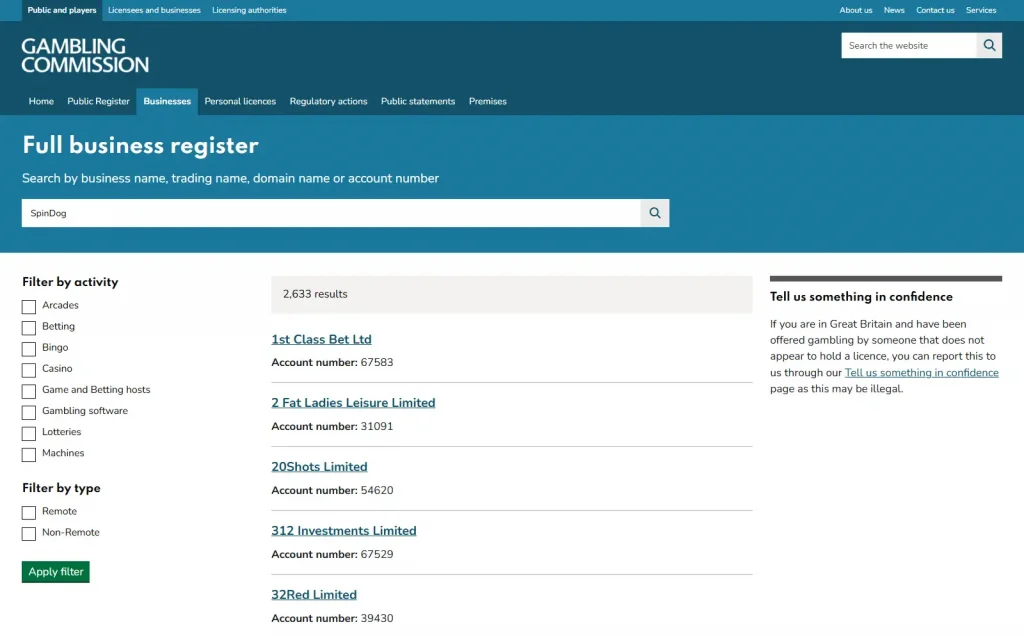
UK licence check
No UK Gambling Commission licence was verified for SpinDog in the public register check used for this guide. That is the clearest licensing fact for a UK reader. It should not be replaced by vague claims that the casino is “licensed somewhere” or by an assumption based on whether the website can be opened. UKGC guidance says remote operators serving consumers in Great Britain need the appropriate Commission licence, while third-party descriptions of SpinDog’s non-UK licence and operator identity conflict and are not treated here as verified.
Verified position
Table of Contents
- What the current evidence establishes
- UKGC status is a specific fact, not a general reputation label
- What UKGC guidance requires from remote casino operators
- A missing verified entry limits the claims that can safely be made about UK protections
- Why this guide does not name a non-UK licence as verified
- Being able to open a casino website is not proof of a Great Britain licence
- Useful evidence beyond the licence check still needs to be classified correctly
- A five-step SpinDog licence verification routine
- The regulatory context belongs next to the licence check, not inside it
- Four shortcuts that produce unreliable answers about SpinDog licensing
- Licence status should be rechecked when the operator, domain or legal footer changes
- What SpinDog's verified licence position means for a UK reader
What the current evidence establishes
| UKGC licence | No SpinDog licence was verified in the public register check |
|---|---|
| Great Britain rule | Remote gambling offered to consumers in Great Britain requires the appropriate UKGC licence |
| Non-UK licence | Third-party claims conflict, so no specific jurisdiction, number or operator identity is presented as verified |
| Website access | Not a substitute for licensing evidence |
| UKGC protections | Not attributed to SpinDog without a verified register entry |
Why the register matters
UKGC status is a specific fact, not a general reputation label
The UK Gambling Commission maintains a public register so consumers can check whether a business is licensed and whether regulatory action is recorded against it. Its consumer guidance also tells users to look for the licensed business name and Commission account number in the footer of a gambling site or app, then verify that information against the register.
For SpinDog, the relevant result is narrow but important: the current check did not verify a SpinDog entry under the brand name or the known domains searched. That supports the statement that no UKGC licence was verified. It does not automatically prove every other question about the brand, such as where individual visitors can technically reach the site, what payment methods appear in a cashier, or what non-UK corporate arrangements may exist.
This distinction is useful because licensing, technical access and marketing visibility are different questions. Combining them into a single “safe” or “unsafe” label would hide the exact evidence a reader needs to assess for themselves.
Great Britain framework
What UKGC guidance requires from remote casino operators
The Commission’s remote-sector guidance says a business needs a licence if it provides facilities for remote gambling to consumers in Great Britain. The rule applies even when the business is based outside Great Britain. The Commission’s remote casino licence guidance covers online casino games such as slots, roulette and blackjack and states the same Great Britain consumer test.
The legal framework is built around the Gambling Act 2005, as amended, together with the Commission’s licence conditions, codes and technical standards. For a consumer researching a casino brand, the practical point is simpler than the legislative structure: a Great Britain-facing licence claim should be independently checkable in the UKGC register.
That is why this guide does not infer UK licensing from English-language content, GBP support or technical availability. Those features can exist without establishing a UKGC register entry.
What a no-hit result means
A missing verified entry limits the claims that can safely be made about UK protections
A no-hit register check means this guide does not attribute a UK Gambling Commission licence to SpinDog. It also means UKGC-specific protections should not be presented as if they are confirmed brand features. Examples include participation in UK-specific self-exclusion or dispute-resolution structures that depend on a licensed operator relationship.
The same discipline applies in reverse. A register result should not be stretched into unrelated claims about whether a withdrawal will be processed, whether a game is fair, or whether a support agent will respond quickly. Those are separate questions requiring their own evidence. The dedicated withdrawal terms guide and verification guide keep those practical account issues separate from licensing.
For a UK reader, this separation is useful because a licence check is strongest when it says exactly what was found and exactly what was not. It avoids creating false certainty from a single signal.
Offshore claims
Why this guide does not name a non-UK licence as verified
Third-party casino directories do not agree on SpinDog’s non-UK licensing position. Some sources describe an offshore licence or operator structure, while others say no gambling licence is known. Without a current authoritative register entry or equally strong primary evidence that resolves those differences, naming a jurisdiction, licence number or operating company as verified would overstate the evidence.
This is especially important for licence numbers. A precise number can look authoritative even when it has been copied from an old review, a different domain, a previous operator or an unrelated licence. The presence of the same number on several affiliate pages is not equivalent to a regulator confirming the number for the current brand and domain.
If SpinDog later publishes a licence statement that can be matched to an authoritative regulator register, that specific fact can be reassessed. Until then, the defensible position is to leave the conflicting non-UK details unresolved rather than choose one version.
Access is separate
Being able to open a casino website is not proof of a Great Britain licence
Technical access can vary by location, device, account state and the website’s own traffic controls. It is therefore a poor shortcut for regulatory status. A page that loads from a UK connection does not establish a UKGC licence, just as a page blocked by a browser tool does not prove that all UK residents are prohibited from holding accounts.
The correct licensing test is documentary: identify the legal business responsible for the site, read the licence statement shown to consumers, and verify it against the regulator. Technical access can be recorded as a separate operational observation, but it should not be used to fill a gap in regulatory evidence.
This distinction also prevents a common mistake in casino reviews: presenting a local licence question as if it were identical to a general availability question. They can overlap in practice, but they are not the same fact.
Trust signals
Useful evidence beyond the licence check still needs to be classified correctly
Licensing is one important trust signal, but readers often look at other evidence too: how clearly the site identifies its legal operator, whether terms are accessible, whether withdrawal conditions are written in advance, whether identity checks are explained, and whether support channels are consistently available.
These signals can help a reader judge transparency, but none of them substitutes for a UKGC register entry. A polished terms page does not create a British licence. Likewise, a negative player review is an opinion or experience report, not proof of a regulatory breach. Reviews are most useful when they identify a concrete issue that can be checked against published terms or a regulator record.
The main SpinDog UK review brings together the broader feature picture. This page stays focused on what can be independently established about licensing.
How to check it yourself
A five-step SpinDog licence verification routine
- Open the UKGC public register. Search the brand name and any legal company name disclosed by the casino.
- Search the website domain. The Commission’s guidance says the register can be searched using the company name or the name of the website or app.
- Read the casino footer and terms. Look for the regulated business name and a Commission account number rather than a generic “licensed” badge.
- Match every detail. The legal entity, domain and account number should correspond to the register record rather than merely sounding similar.
- Keep other jurisdictions separate. If the site names a non-UK regulator, verify that claim with that regulator rather than assuming it satisfies the Great Britain licensing requirement.
This routine is intentionally mechanical. It reduces the risk of relying on search snippets, copied review text or visual badges that cannot be traced to a regulator.
UK-specific rules
The regulatory context belongs next to the licence check, not inside it
Great Britain has specific rules for licensed operators covering matters such as credit cards, online slot stake limits, financial vulnerability checks and customer-set financial limits. Those rules are important when comparing what a UKGC-regulated environment requires.
They should not be described as verified SpinDog account controls unless the brand’s UKGC status is established. The separate UK player rules guide explains those requirements with their effective dates and keeps the scope explicit.
That approach matters because a reader can understand the UK benchmark without confusing the benchmark with a claim about this particular brand.
Common licence-check errors
Four shortcuts that produce unreliable answers about SpinDog licensing
The first shortcut is trusting a review badge without opening the regulator record behind it. A badge can be outdated, copied or based on a different operating company. The second is treating a casino’s currency selection as a licence indicator. GBP support is a product feature, not a UKGC record.
The third is assuming that a provider list proves regulatory approval. Game studios can distribute content through different commercial arrangements and jurisdictions, so the appearance of a familiar provider does not answer who regulates the casino operator. The fourth is treating a website footer as conclusive without matching its business name and number to the regulator. Footer wording is a useful starting point, but the register is what turns that wording into independently checkable evidence.
These checks are deliberately conservative because licence claims are easy to repeat and difficult for a reader to unwind once an incorrect company name or number spreads across comparison sites. Keeping each piece of evidence attached to its original source makes later updates easier too.
When the answer can change
Licence status should be rechecked when the operator, domain or legal footer changes
Casino brands can change ownership, operating entities, domains and regulatory arrangements. A register check is therefore dated evidence rather than a permanent characteristic of a brand name. If SpinDog begins displaying a new legal company, a UKGC account number or a different regulated domain, the correct response is to repeat the register search using those exact details.
The same principle applies to third-party claims. An older review may have described a licence that was valid for a previous operator, or it may have copied a claim that was never independently verified. A fresh authoritative register result should take priority over an undated comparison page.
For that reason, readers should note the date of any licence assessment they rely on and prefer regulator records that show the current entity and domain relationship.
UK reader takeaway
What SpinDog’s verified licence position means for a UK reader
The strongest current conclusion is precise: no UK Gambling Commission licence was verified for SpinDog in the public register check used here, while UKGC guidance says remote businesses serving consumers in Great Britain require the appropriate Commission licence. Conflicting third-party descriptions do not provide a sound basis for naming a specific offshore licence, licence number or operator identity as verified.
For a UK reader, the practical consequence is to avoid assuming UKGC-linked protections simply because the site can be reached or uses familiar UK-facing features. Check the regulator record directly, keep licensing separate from cash-out terms and account verification, and reassess the position if authoritative licence evidence changes.